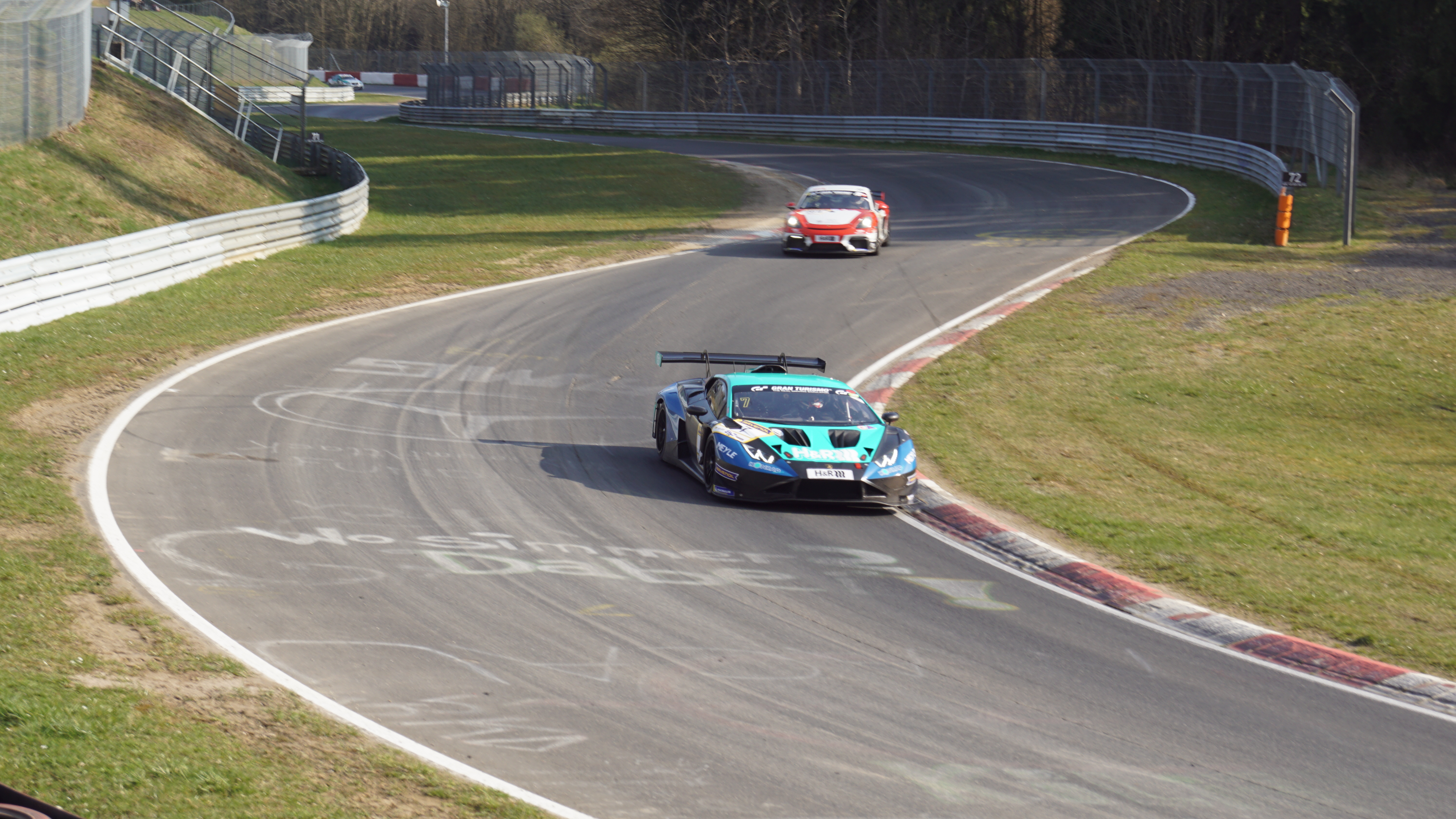
• Successful racing debuts for Chloe Chong, Patricija Stalidzane and Siri Hökfelt in the NLS

    Last weekend’s NLS (Nürburgring Endurance Series) race was particularly significant as it marked the true start of the 2026 season, following the cancellation of NLS 1. The event showcased the remarkable talent of three talented young women, Chloe Chong, Patricija Stalidzane, and Siri Hökfelt, who all made their racing debuts in this high-stakes competition. Each of them demonstrated impressive skill and resilience, despite facing numerous technical challenges and setbacks throughout the day.

    Photo by Mika Böcker

    The second NLS race of the season, following the cancellation of NLS 1, in fact represented the true season opener. The planned race debuts of Chloe Chong and Siri Hökfelt, originally scheduled for that race, had therefore to be postponed to this event. As part of the Girls Only Team and its development program, both completed several laps on the test day of the first race, but did not actually compete. For Chong, this was enough to secure the Nordschleife permit she had been aiming for. Hökfeld hadn’t yet completed enough laps, but was able to make up for it in the following week. She started alongside Carmen Kraav and Elena Egger in the #503 Toyota Supra, while Chong shared the BMW 228i with Garbe. Both cars competed in the VT2-RWD class. EuroNASCAR Lady Trophy winner Happinessa was also set to make her NLS debut, also aiming for her permit. While she managed to complete several laps on Friday and in practice, her race debut was thwarted by gearbox problems that eventually prevented her from starting the race. Another debut – not at the racetrack but in new machinery – saw Patricija Stalidzane, known from the Girls Only Team, competing for the first time with Konrad Motorsport in a GT3 car. In addition to the aforementioned debutants, Carrie Schreiner, Fabienne Wohlwend, and Janina Schall were also entered in the Girls Only Team, along with Katharina Lippka in the Bitter Corsa, Miki Koyama in the Toyo Tires Toyota, and Flavia Pellegrino Fernandes in a VW Golf 8.

    Photo by Mika Böcker

    Things didn’t go entirely smoothly for the women’s teams in the NLS on Friday. The Girls Only team couldn’t get their Porsche Cup on the track and had to change the engine over the afternoon and night. The other female-driven cars also took their time getting out on the track. Only Pellegrino Fernandes’ Golf managed to complete numerous laps. It wasn’t until late afternoon that the last teams finally started their runs before the session had to be interrupted due to an accident.

    Photo by Mika Böcker

    All the cars were ready for qualifying. Both the Girls Only Porsche and the Bitter Corsa completed a few installation laps before attempting to qualify. The Konrad Lamborghini initially held pole position until the main body of the GT3 pack moved to the front. The chase for the fastest time was interrupted after just 45 minutes due to a Code 60 zone in the Hohenrain section. Chloe Chong’s #506 was pushed into the pits at the same time. The mechanics worked on the front of the car until the race start. When the session restarted, lap times improved dramatically. At least until a few minutes before the end. Fabienne Wohlwend was in the wall after an accident in the Wippermann section. The #47 GT3 had attempted to overtake her there (a spot where it’s usually nearly impossible), hitting the Porsche’s rear axle and sending it crashing into the wall. The left side was completely destroyed, the car beyond repair. A complete debacle following the engine change the previous day. Wohlwend remained unharmed, and the situation went unpunished.

    Photo by Mika Böcker

    Paul started the race in the Konrad Lamborghini from 7th place, but dropped to 8th in the first lap. The next best female-driven car was the #170 Toyota driven by Miki Koyama in 40th place. Kraav started the Supra from the Girls Only junior team and came out of the first lap in 105th place. Further back, Strycek followed in the Bitter Corsa in 120th place, and Chloe Chong was at the back of the field. Chong had a problem in the Fuchsröhre section, then drove through the pitlane, but was able to continue the race. Happinessa and the Girls Only team were unable to start the race at all.

    Photo by Mika Böcker

    Both the Konrad Lamborghini and the Toyo Tires Toyota lost several positions in the opening laps before stabilizing. Kraav and Strycek also dropped back slightly, but to a lesser extent. The first Code 60 zone in the race didn’t take long to materialize. A car came to a halt after contact in the Mutkurve section. With five laps already completed in each class, the first teams began pitting. They tried to minimize time loss, as the slowed-down section, under the green light, is one of the fastest parts of the track. None of the all-female teams pitted, allowing them all to move up the field.

    Photo by Mika Böcker

    After an hour, Paul in the Konrad Lamborghini is back in 6th place, Kotaka in the #170 Toyota is in 45th overall and third in class. Kraav remains in 115th place and 10th in the VT2-RWD class, followed by Chloe Chong in 119th overall. Just ahead of them is Strycek in 113th overall and second in his class. The standings soon need to be corrected. Shortly after the mark, Koyama stops at the pit exit after his pit stop. What initially appears to be a problem during the pit stop quickly turns out to be an irreparable technical defect. Shortly afterward, the Bitter Corsa is also towed away. Although it can continue after repairs, it loses several laps and is therefore out of contention. The race is further slowed by Code 60 at Döttinger Höhe and in the Bergwerk section. Now the Konrad Lamborghini also comes into the pits. Engelhardt takes over the car. Kraav came in after 80 minutes of racing, but complained of car problems. After a quick check, during which no major issues were found, the regular pit stop was made and Elana Egger took over. Lippka had also been ready to take over the Corsa, but this was aborted due to the technical problems.

    Photo by Mika Böcker

    By the halfway point of the race, the number of female drivers had significantly decreased. The Konrad Lamborghini remained the highest-placed of them, in 11th overall and 10th in class. Schönfeld, driving the Golf 8, followed in 73rd place overall and silver in her class. Next came the Girls Only junior team in 109th place and 8th in class, ahead of Chong’s BMW. The Corsa was several laps back in 120th place. Shortly after the halfway point, Patricija Stalidzane took over the Lamborghini for the third stint, making her GT3 racing debut. The other all-female cars remained on the track for a while longer.

    Photo by Mika Böcker

    On lap 5 of her stint, Egger radioed in problems with the car. There had also apparently been contact with a wall on the track. However, the car was able to continue without significant time loss. A missing mirror and a malfunctioning gearbox were reported as the issues. But these also seemed to have resolved themselves. Egger therefore didn’t pit, but the crew prepared for repairs and check-ups. Egger finished her stint as planned. In the pits, shortly before the start of the final hour, a damaged right front side and various minor damages on the right side were visible. However, the damage was completely repaired during the stop. The parallel analysis also showed no gearbox problems in the system. Later, it was discovered that a ground fault in the steering wheel wiring was preventing the paddle shifter signals from being transmitted when the radio button was pressed simultaneously. The team therefore minimized radio communication with Siri Hökfelt, who had now taken over the car. The Swede was thus making her race debut on the Nordschleife after the test days. She is unaware of the previous problems due to the radio silence.

    Photo by Mika Böcker

    Stalidzane begins the final hour of the race in 12th place overall and 9th in her class. Pellegrino Fernandes’ team remains in 2nd place in their class and 82nd overall. After their pit stop, Hökfelt moves up to 102nd place overall and 8th in her class. She’s driving a bit more cautiously than her more experienced teammates, but she’s not losing too much time. Close behind is car #506 in 10th place overall and 107th in the class. The Corsa is holding its own in 113th place, with Schäffer at the wheel. Lippka will not be getting back in the car. For the final stint, Engelhard will take over the Konrad Lamborghini and Flavia Pellegrino Fernandes will drive the Golf 8. This completes the final pit stops for the all-female teams. Many more pit stops are still pending across the field. Hökfelt in the Supra benefits the most from this, managing to climb into the top 100 and 7th in her class. On the long Nürburgring track, she is only 20 seconds per lap slower than her teammates. Hökfelt describes her first Nürburgring race positively. “It was really good. I had fun.” She didn’t notice any shifting problems, but something else did: “At the end of the stint, coming out of the corners, it sometimes felt like the car wasn’t accelerating at full power. But apart from that, it felt good.” Hökfelt had already struggled with the traction control on Friday. Whether it intervened too much again remains speculation.

    Photo by Mika Böcker

    In the overall standings, everyone moved up one position, as the winning Mercedes #3 was subsequently disqualified. Stalidzane’s Konrad Lamborghini thus finished 7th overall, the same as in her class. Pellegrino Fernandes brought her Golf 8 home in 81st place, 2nd in her class. The Girls Only Junior Team finished 98th overall, ahead of Chloe Chong in 103rd. They took 8th and 10th place in the VT2 RWD class. Lippka’s team secured the silver medal in the SP2T class with an overall finish of 104th. The other all-female teams either did not finish or were unable to start. In the Ladies Trophy, Pellegrino Fernandes leads with 11 points after this race, ahead of Stalidzane with 3 points. This is because the class results, not the overall results, are being evaluated in this category. The other women are not registered for this standings.

    The next race in the series will take place on April 11, 2026. This will be the last race before the 24-hour race and its qualifying race.
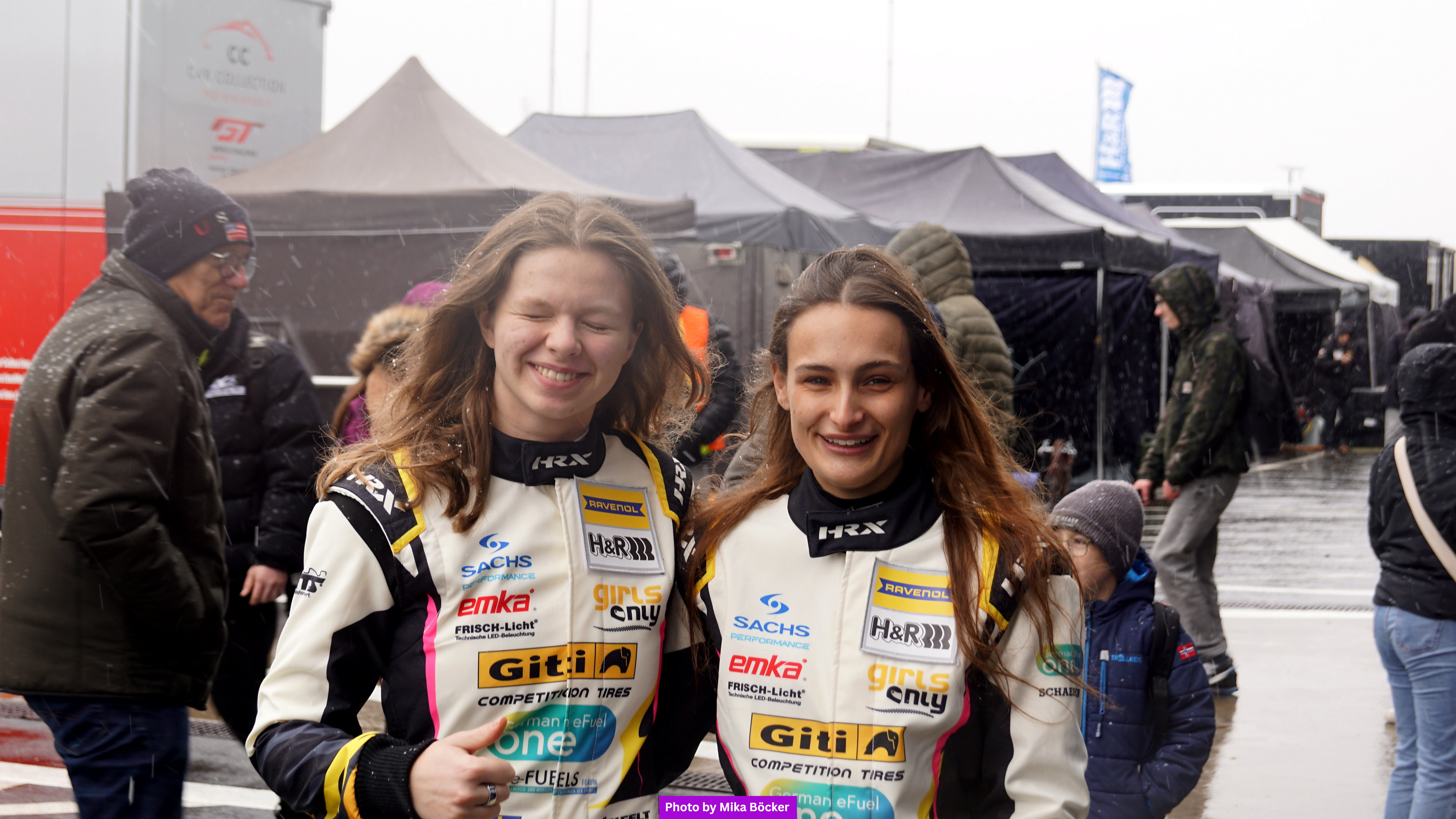
  • Snowfall Cancels NLS 1

    Our first visit with official media accreditation is cut short by the notorious Eifel weather.

    In cooperation with our partner magazine “Racers – Behind the Helmet” (or simply “Racers”), I’m attending the NLS this year not just as a fan, but as an officially accredited journalist. In recent years, I’ve been a regular at the track and reported on the well-known Girls Only Team and their races last season. This year, the team has expanded with a junior team, and we’ve also broadened our coverage. I’ll be reporting live from the track throughout the entire NLS season, covering the team, the races, and the other female drivers. I won’t just be limiting myself to typical reports, but will also be sharing my experiences and personal impressions from the track, as in this diary-like format.

    The NLS season opener didn’t exactly get off to a good start. The weather forecast had been poor for days and proved accurate by mid-morning. Cold temperatures, light fog, and especially the rain caused problems. I was already soaked on my way from my car to the paddock. At the entrance, I first collected my accreditation and press pass – a special occasion for me. As described above, I’d always been there as a fan, but now the experience was taken to a whole new level. With this pass, I familiarized myself with the paddock and introduced myself to the individual drivers and teams I wanted to write about. Of course, not everyone had time for me, as the test and setup runs were underway. But everything went well, especially with Girls Only. Some of them already knew me, and I introduced myself to others. The Porsche Cup car was currently out on the track with Fabienne Wohlwend, but I got talking to Janina Schall. She told me that the conditions were quite tricky, but the Porsche also performed well in the rain. “First time with a new car on the Nordschleife, and then straight away in the rain. I wasn’t there for testing in Valencia. We’re getting used to the car and feeling our way around before we push for wins,” she explained.

    Interview with Janina Schall – Photo by Mika Böcker

    In addition to the main Girls Only team, the crew has expanded to include a junior team. The team will be competing with a Toyota Supra, giving young drivers the opportunity to obtain their racing licenses. Among them is a driver we’ve been following for some time with Racers: the Swede Siri Hökfelt. My co-author has been writing about Siri since she was 15. The Swede was very happy to meet a new colleague from our writing team. Her car was still in the pits, and teammate Elana Egger was getting ready for the run. Siri had already been in the car and explained to me that she would get back in after Elana and stay out until the end of the practice session.

    Siri Hökfelt on track – Photo by Mika Böcker

    After speaking with everyone I knew and introducing myself, I left the paddock for my first photo spot. I wasn’t supposed to get a photo vest, which would allow me to go right up to the guardrail, until Saturday. So I made do with a camera spot in the catch fence. First up was the Sabine Schmitz corner. The beginning of the Nordschleife was good for a few slow shots. Meanwhile, the rain was getting heavier, and the temperatures were dropping significantly. Although over 130 cars were registered, there were only a few different teams left on the track. Nevertheless, I managed to get many good photos, especially of the all-female teams. Siri was already in the Toyota at that time. She was still new to the track, and you could tell she was cautiously getting used to it. But already on the second lap I saw her on, she was noticeably faster and engaged in a little duel with another Supra. Overall, there was plenty to see in the corner despite the light traffic. There were repeated instances where the drivers underestimated the wet conditions or the banked corners. They repeatedly slid too wide, struggled to control drifts, or pushed the traction control to its limits.

    Photo by Mika Böcker

    The second point was the entrance to Hatzenbach. Here, the pace was naturally much faster, but the scenery was no less spectacular. Unfortunately, the practice session was already drawing to a close, and there weren’t many cars left to see. The few that were there, however, provided excellent entertainment. This made it entirely worthwhile to stand in the pouring rain for two hours at 2°C. My equipment thankfully survived as well. The walk back, however, was anything but pleasant in that weather.

    Photo by Mika Böcker

    Saturday morning, according to the accreditation email, I was supposed to pick up the photo vest for extended access. Arriving at the Media Center, I was in for a surprise. I wasn’t going to get one after all. They deemed the vest, or rather the granted access, unnecessary for us, and therefore only issued journalistic accreditation. According to the officials on site, standard access would be perfectly sufficient after evaluating our work. Why this was the case, or why they had previously informed me that I could pick up a vest, remains unclear. So, I went to the garages without a vest. I had plenty of time, as it had even snowed overnight and the Sessions were delayed.

    The start of training was initially delayed due to the snow. Then fog and cold set in. New information was expected at 10:00 AM, after the usual training time had ended. In the meantime, I chatted with various people from Girls Only. Car Chief Nina approached me, among others, because she had often seen me there as a fan. Since the delay had given her some free time, she was able to talk to me. I briefly explained who I am, what I do here, and how I got involved. We talked about her job in the team, the car itself, and the challenges of competing in the AT class. A unique rule in the alternative fuels class is that refueling and the rest of the pit stop cannot happen simultaneously. There’s a separate pit lane for this. However, the refueling systems aren’t fully developed. “Last year, we had a refueling system that was basically powered by a car battery. Naturally, it didn’t deliver much fuel, and we lost up to five minutes per stop,” I was told. “Now we have a proper system and should have another minute after refueling. Tire changes should take 30 seconds, and the girls will then have a minute,” she continued. She also described the driver lineup for the upcoming season as positive. Yesterday, the junior and debutant drivers Siki Hökfelt and Chloe Chang were able to gain valuable experience. This should allow Chloe to move up to a faster car in the future. In that context, we also discussed the general licensing and permit system for the Nürburgring and sim racing. The licensing regulations turned out to be quite confusing. However, we were able to exchange valuable experiences and have a stimulating conversation about sim racing. Then it was time for race control to release new information, so we had to say our goodbyes.

    Photo by Mika Böcker

    My next conversation was with Siri Hökfelt again. The main topic was, of course, her training session from the previous day. She had a good feeling about the drive, and although the conditions and the track were very challenging, she enjoyed it. “It was good, but not easy. It’s a big track, and there’s a lot and a lot to learn. The track is very difficult.” Despite everything, she’s convinced she’ll manage it and master the track. She’s looking forward to the season at the Nürburgring and with the team. When asked about the Girls Only Team and her teammates, she was very positive and happy. She feels very welcome: “They are all super nice,” and she’s having a lot of fun with them. As far as I could see that day, everyone in both Girls Only Teams was having a lot of fun, even though they would have preferred to be driving. Siri and I then discussed whether and when the day’s events would begin.

    Elana Egger & Siri Hökfelt, Girls Only Junior Team – Photo by Mika Böcker

    While we were still talking, a crew member from her car came over to us and explained that there was no news yet. First in German, then in spoken English, she informed us that the conditions in the Hohe Acht section were still bad. Since Siri doesn’t know all the corner names by heart, I briefly explained where the section was located. Shortly after we had clarified that, the information came: Race cancelled. The race was completely cancelled due to snow and cold, without a replacement date. The situation in the paddock still seemed peaceful, so we were all accordingly surprised and disappointed, especially the girls, of course. Elana Egger also came over to us, and we talked about the weather. Since we now had some time, I took a few pictures in front of the Toyota with Siri’s father. We had barely finished when Elana spotted through the windows that it had started snowing again in the paddock. She happily ran outside into the snow with Siri. Siri’s father and I followed and took a few more snapshots.

    Siri Hökfelt & Elana Egger, Girls Only Junior Team – Photo by Mika Böcker

    We talked for a while about the canceled race, the missed opportunities regarding the permit, and the rest of the season. The Girls Only Team then brought the day to a close together. All the drivers gathered, chatted, motivated each other, and cheered each other up. They filmed their social media stories with the Porsche that had been pushed outside. Afterwards, they gave us media people the opportunity to take a few more photos. Such a perfect opportunity rarely presents itself during the regular races of the season. Besides the drivers, the team that works on the car also joined us. Although a race wouldn’t be possible without them, they otherwise receive little attention and recognition. That’s why it was all the more wonderful to get this part of the team together as well. In this sense, I would like to thank the team for their work. They enable women who otherwise have few to no opportunities in motorsport to participate in this sport.

    Girls Only Team with it’s crew members – Photo by Mika Böcker

    After this last photo session, there was nothing left for me to do at the track. So I made my way back, as did most of the remaining people from the Nürburgring. The Ring Boulevard was packed, but unfortunately most of the fan shops had already closed, so frustration was palpable everywhere.

    Drivers of the Girls Only Team – Back row from left to right: Janina Schall, Patricija Stalidzane, Fabienne Wohlwend. Front row: Elana Egger, Chloe Chong, Siri Hökfelt – Photo by Mika Böcker

    Next weekend, the rescheduled NLS 2 race will take place. I’ll be there in person and will take you along in this diary-style format. We all hope the weather will be better, but nobody can ever predict that.

  • Strong female participation leads to several top ten results in the Formula Winter Series

    F1 Academy debutante Mathilda Paatz and Chiara Bätting achieved top ten results in Aragon while the other three women were unable to reach top positions after tough races.

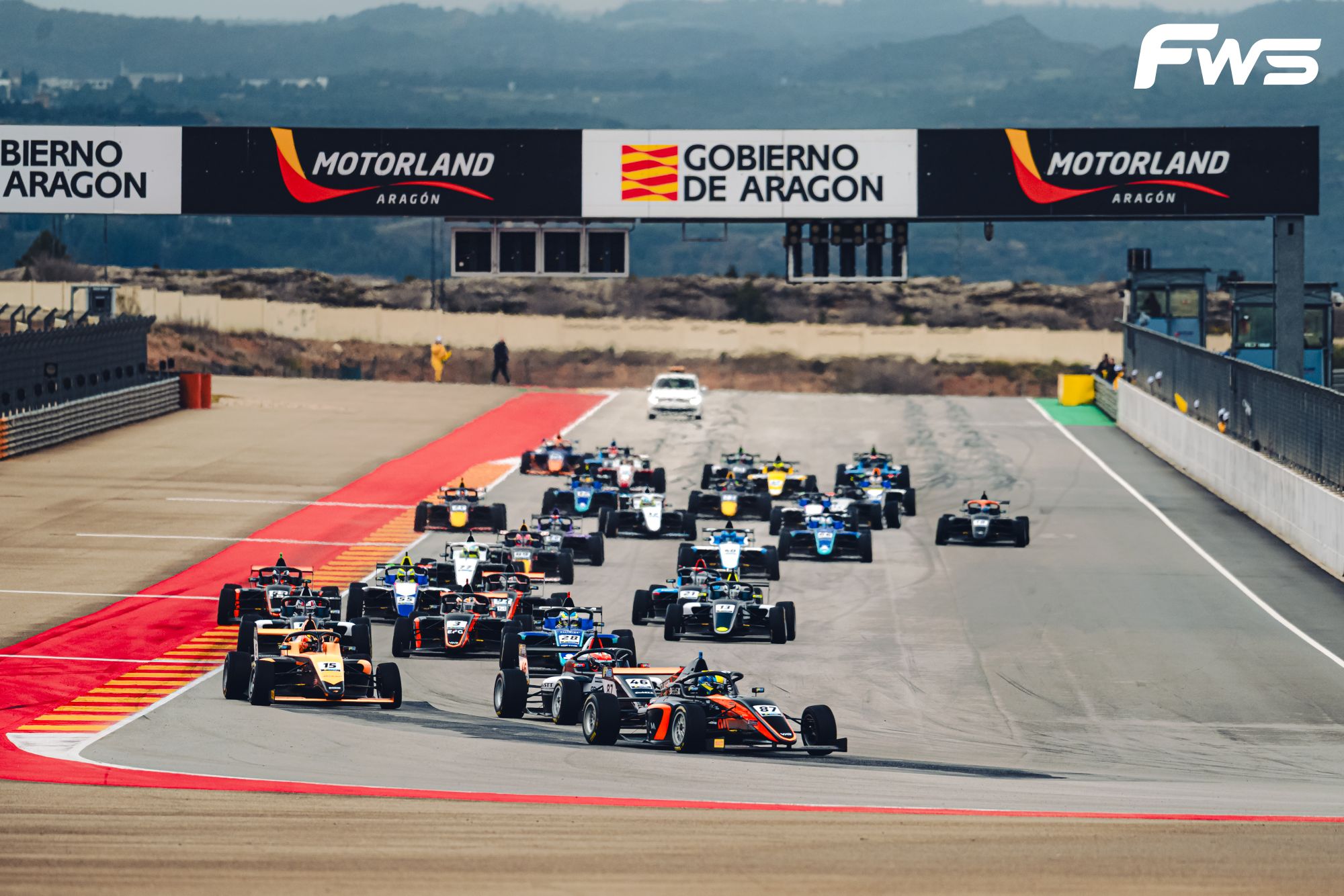
    The image depicts a thrilling scene of a large group of race cars speeding around a turn on a racetrack.

The racetrack is filled with approximately 20 sleek, open-wheel race cars, each with its own unique design and color scheme, jostling for position as they navigate a turn. The cars are all traveling in the same direction, with their drivers intently focused on the road ahead. Although their facial expressions are not visible, their body language conveys a sense of intense concentration and competitiveness. The cars are adorned with various sponsor logos and numbers, adding to the sense of authenticity and professionalism.

The racetrack itself is a well-manicured, paved circuit with a red and orange curb marking the edge of the track. A white line separates the racing surface from the adjacent lane, while a low wall and guardrail line the right side of the track. In the background, a series of large billboards and advertisements are visible, including one that reads "MOTORLAND ARAGON" and another that says "GOBIERNO DE ARAGON". A white car is visible in the distance, driving on a separate section of the track. The surrounding landscape features a desert-like terrain with sparse vegetation and a mountain range rising up in the distance.

The overall atmosphere of the image is one of high energy and excitement, capturing the thrill and intensity of competitive racing. The bright colors and dynamic composition of the image draw the viewer's eye to the action on the track, creating a sense of tension and anticipation. The presence of the "FWS" logo in the top-right corner suggests that this may be a professional racing event, adding to the sense of authenticity and prestige.
    Photo by Gedlich, Formula Winter Series

    In Saturday’s race, the women of the Formula Winter Series had to fight their way to the front. Chiara Bätting had the best starting position among them, in 18th place. She was followed by Alisha Palmowski, Mathilda Paatz, Megan Burce, and Ginevra Pazeri in positions 21 to 25. The conditions for the first race were not ideal; it had rained beforehand, and more showers were forecast. Nevertheless, the start went smoothly for the women. Only in the midfield were there a few minor slides and collisions. After the first lap, Bätting led the Female Trophy from 12th place overall. Palmowski was already close behind and trying to take the class lead. Mathilda Paatz moved up to 17th position but lost these positions again in the following minutes. Bruce and Pazeri remained outside the top 20.

    Still in the second lap, Palmowski overtook Bätting, who was struggling with the weather conditions. The two Red Bulls lost further positions as the fast but unqualified riders came from behind. After 10 minutes, Palmowski was only leading the Female Trophy from 13th place overall, while Bätting dropped back to 16th and Paatz to 21st. Grosso continued to put Palmowski under so much pressure that she received a 5-second time penalty for exceeding track limits – a problem many riders would share due to the weather. Paatz also received this penalty just 5 minutes later. Bruce followed suit 5 minutes after that. Before that, however, she managed to overtake Kammerlander after a long battle. Overall, penalties increased across the field towards the end of the race. Palmowski was hit particularly hard, with her penalty increased to 25 seconds. In the end, the final standings were not decided by crossing the finish line, but by the penalties. Bätting secures her first victory in the female trophy this weekend.

    The image depicts a thrilling moment in a Formula racing competition, showcasing a group of sleek, high-performance cars navigating a curved section of a racetrack.

The cars, adorned with vibrant colors and numbers, are the main focus of the image. The lead car, bearing the number 18, takes center stage, followed closely by its competitors. The drivers, clad in helmets, are intensely focused on the track ahead, their faces obscured from view. The cars themselves are a marvel of engineering, with aerodynamic designs and bold color schemes that reflect the teams' and sponsors' branding. As they speed around the curve, their tires appear to be gripping the asphalt, conveying a sense of high-speed maneuverability.

The racetrack itself is a masterpiece of design, featuring a bold red and yellow curb that demarcates the edge of the track. A low wall, constructed from metal guardrails, runs along the outside of the curve, providing a safety barrier for the drivers. Beyond the track, a cloudy sky looms, casting a dramatic backdrop for the racing action. The overall atmosphere is one of high energy and tension, as the drivers push their vehicles to the limit in pursuit of victory.

The image exudes a sense of dynamism and competition, capturing the essence of Formula racing. The presence of the "FWS" logo in the top-right corner suggests that this is an official or promotional image, possibly from a specific racing series or event. Overall, the image is a testament to the speed, skill, and strategy involved in Formula racing, making for a captivating and exhilarating visual experience.
    Photo by Gedlich, Formula Winter Series

    The starting positions for the second race were much more promising. Bätting secured 6th place. Palmowski, Paatz, and Bruce finished 12th, 14th, and 16th, respectively. Pazeri brought up the rear, outside the top 20. While the start itself was clean again, there was a very clear false start in the middle of the pack. However, this had no bearing on our women and was duly penalized shortly afterward. Bätting maintained her 6th place after the first lap. Paatz was very successful with overtaking and had already moved up to 9th place, two places ahead of Palmowski. Bruce, in contrast, had problems and dropped back to 23rd. Pazeri at least held onto 25th place.

    In the following laps, Palmowski and Paatz also lost positions, dropping back to 12th and 11th place respectively, although Paatz was still able to fight for a top-10 finish in the first half of the race. Palmowski, however, fell back and even dropped to 15th place before a puncture took her out of the race completely. Bätting’s luck also ran out; after almost 20 minutes of racing, she dropped back one place.

    Bättig then found herself in a fierce battle. In the final minutes of the race, those in positions 7 through 15 constantly fought for better positions. Bättig and Paatz were right in the thick of it. The latter managed to overtake Bättig in the final laps, securing 9th place and the victory in the female trophy, while Bättig, after a good race, dropped out of the top ten.

    The image depicts a Formula-style race car navigating a turn on a racetrack.

The race car, bearing the number 89 on its front, is a sleek, open-wheel vehicle with a predominantly black body accented by vibrant yellow and red details. Its driver, clad in a helmet and protective gear, is focused on the track ahead. The car's tires are screeching as it takes the turn, with smoke visible from the rear right tire, indicating a high-speed maneuver. The vehicle's design and the driver's gear suggest a high level of professionalism and competition.

The racetrack itself features a distinctive red and yellow barrier along its edge, with a black fence and a backdrop of rolling hills and greenery beyond. The track's surface appears worn, with visible tire marks and scuffing, indicating frequent use. In the distance, power lines and a hazy mountain range are visible, adding depth to the scene.

The overall atmosphere of the image is one of high-energy competition, with the car's dynamic pose and the driver's focused expression conveying a sense of intensity and skill. The bright colors of the car and track barriers add to the vibrant mood, while the natural scenery in the background provides a sense of contrast between the high-speed action on the track and the serene landscape beyond. A watermark in the top-right corner, "FWS," suggests that the image may be associated with a racing series or organization.
    Photo by Gedlich, Formula Winter Series

    The final race didn’t go smoothly for all the women either. Pazeri collided at the start and had to park her car on the track, triggering the first safety car of the weekend. Bätting was in 17th place at that point, leading the Female Trophy standings. Paatz was right behind her. Palmowski followed in 21st place, and Bruce was in 25th.

    The race restarted after 5 minutes. The three leading women were able to gain positions in the first full lap. Paatz remained stuck behind Bätting, with Palmowski not far behind her. However, the chase was interrupted after only a few minutes. Bansal crashed, as did Kostin, number 97, and the safety car was deployed again. Bätting was thus stuck in 14th place, as were Paatz in 16th, Palmowski in 17th, and Bruce in 23rd.

    The second restart came just in time for the halfway point of the race. However, before the green flag was waved, several cars collided in the hairpin. Fortunately, the women were uninvolved and were able to continue the race undisturbed. The resulting pit stops even allowed them to gain some positions. Bruce, however, was unable to make much headway against Chatier and Killion and lost ground again. After two-thirds of the race distance, Borenstein retired with a broken suspension, bringing out a third safety car. The women’s positions remained unchanged up to that point.

    The final restart occurred with just over two minutes remaining. Batting used the limited time to move back into the top ten. Bruce also made a strong move, improving from 24th to 21st. Paatz, however, lost another place but still managed to secure 15th, ahead of Palmowski.

    The image depicts two young women in racing suits walking on a pit lane, surrounded by people and race cars.

The two women are the main focus of the image, walking side by side on the pit lane. The woman on the left has short brown hair and wears a black and blue racing suit with various sponsor logos, including "sd" on her chest. She holds a black helmet in her right hand. The woman on the right has short blonde hair and wears a black racing suit with a prominent Red Bull logo on her chest. She holds a multicolored helmet in her left hand. Both women wear black shoes and appear to be walking towards the camera. Their expressions are neutral, and they seem to be engaged in conversation.
In the background, several people are standing around, some wearing similar racing suits or team uniforms. A few individuals are holding cameras or other equipment, suggesting that they may be part of the media or support team. On the left side of the image, a blue and white race car is visible, with a crowd of people gathered around it. The car features a prominent "LIQUID MOLY" logo on its side. The pit lane stretches out behind the women, with a cloudy sky above. The overall atmosphere appears to be one of preparation and anticipation, as if the women are about to participate in a race or event.

The image conveys a sense of professionalism and focus, with the two women at the center of attention. The presence of the media and support team adds to the sense of importance and excitement. The cloudy sky above creates a sense of uncertainty, but the overall mood remains positive and energetic. The image effectively captures a moment in time, freezing the action and emotions of the scene.
    Photo by Gedlich, Formula Winter Series

    With these strong results, the drivers have prepared well for their upcoming season. The series finale will take place in Barcelona from March 12th to 15th – coinciding with the start of the F1 Academy, meaning not all drivers will be able to participate in the final.

  • Rio Shimono achieves three Top 10 results at the start of the Formula Regional Japanese Championship season

    In the first three races in Suzuka, Rio Shimono finished 8th twice and 7th once.

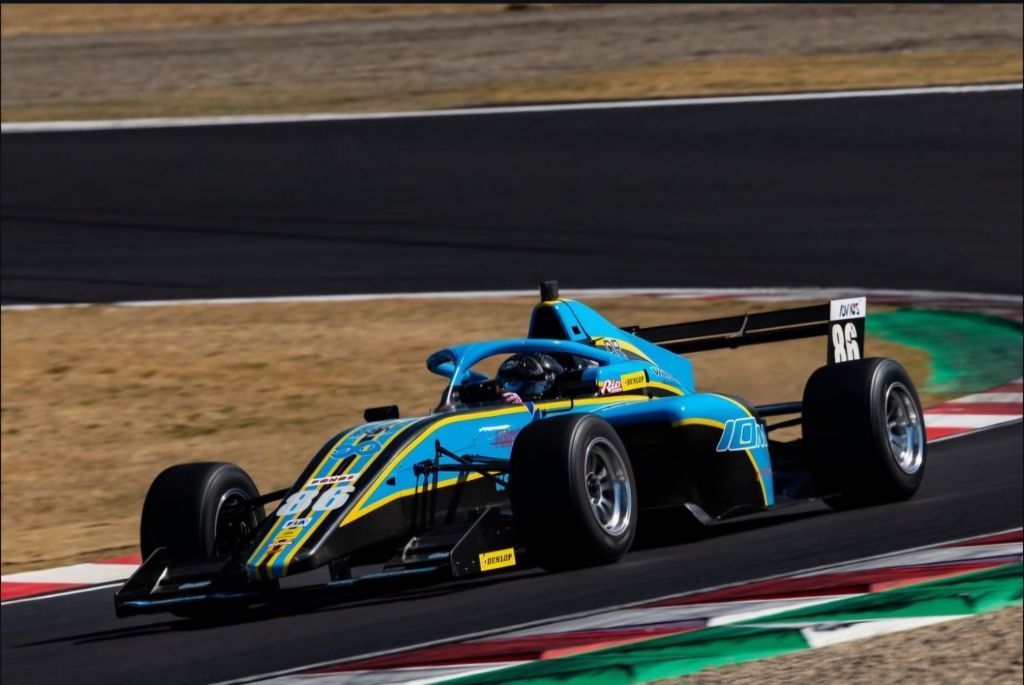
    The image depicts a blue race car speeding along a track, with the driver wearing a helmet and the car's number "86" prominently displayed.

The race car is a sleek, open-wheel vehicle with a vibrant blue body adorned with yellow and white accents. The number "86" is emblazoned on the side of the car in large white numerals, accompanied by smaller logos and sponsorships. The driver, clad in a black helmet, is visible through the cockpit window, intently focused on the road ahead. The car's tires are black, and its rear wing is black with a white sign bearing the number "86" in black.

In the background, the asphalt track stretches out, flanked by a grassy verge that gradually gives way to a dirt area. A red, white, and green striped curb lines the edge of the track, adding a pop of color to the scene. The overall atmosphere is one of high-speed excitement, capturing the thrill of competitive racing.

The image conveys a sense of energy and dynamism, with the car's motion blurred slightly as it hurtles around the track. The driver's helmeted head is visible, conveying a sense of focus and determination. The surrounding environment, including the track and verge, provides context for the action unfolding in the foreground. Overall, the image effectively captures the essence of high-performance racing.
    Photos by Rio Shimono

    After winning the Kyojo Cup last year, Shimono is competing this year for the Dr. Dry F111 team in the Formula Regional Japanese Championship. She already demonstrated in qualifying that the move up was a wise one, starting the first two races from the middle of the field and the final race from the second row.

    Shimono started the first race from 7th place out of 16. She got off to a good start and briefly managed to get close to the front, but couldn’t quite capitalize on it in the twisty first sector. She therefore remained in seventh place, but was right on the tail of the rider in front. Especially in the early laps, there were many small riding errors, and many riders had to take the escape route at the final chicane. Unfortunately for Shimono, none of them lost enough time to end up behind her.

    After the first few laps, the riders’ strengths and therefore the lap times stabilized. The gaps between them grew ever larger. Shimono could no longer keep up with the rider in front of her, but she had to be careful that Xuanyu didn’t overtake her. She managed to do so until four laps before the end of the race. But then she made a small mistake and lost the position after all. She therefore finished her first race in eighth place.

    The image depicts a Formula 3 racing event at the Suzuka Circuit, with a group of cars speeding down the track.

In the foreground, a pack of Formula 3 cars is visible, all facing the same direction and moving towards the camera. The cars are a mix of colors, including orange, white, blue, red, and black, and feature various sponsor logos on their bodies. The drivers are not clearly visible due to their helmets and the distance from the camera. The track itself is a dark grey asphalt, with white lines marking the lanes and a yellow line on the left side.

Above the track, a large black sign with white text reads "SUZUKA CIRCUIT" and features a stylized logo to the left of the text. In the background, a grandstand is visible on the left side of the image, while a grassy hill and trees can be seen on the right. A few buildings and power lines are also visible in the distance. The sky above is a clear blue, indicating a sunny day.

The overall atmosphere of the image is one of excitement and energy, capturing the thrill of a live racing event. The Suzuka Circuit is a renowned racing track in Japan, known for its challenging layout and high-speed corners, making it a popular venue for Formula 3 and other racing series.
    Photo by Rio Shimono

    In the second race, Shimono started from eighth place. She got off to a good start again and was able to briefly attack on the inside. However, she ran out of room in turn two. While she had to brake, she was overtaken on the outside and dropped back to ninth place. She couldn’t find a way to counter for the remainder of the lap. At the end of the first lap, Akamatsu suddenly pitted and stopped the car. Shimono inherited eighth place and was stuck in the gearbox of the group ahead. The flowing track layout made overtaking difficult, and she was trapped there. Meanwhile, the battle in the leading group intensified. On lap five, disaster almost struck when one of the cars slid in corner 130R and nearly caused a serious crash. The driver managed to regain control in time. Further back, Shimono couldn’t find a way past Akita until the end of the race. Instead, she fell further and further behind and crossed the finish line four seconds behind him.

    The last race held a promising third starting position for Shimono. However, the car in second place stalled at the start. Instead of celebrating inherited second place, she had to let the second Ponos Racing car, which had a perfect start, pass her. She managed to hold onto third place for the first lap before losing a position on the approach to the first corner in the second lap. She had already had to defend her position in the 130R and the chicane, which meant she lacked momentum for the straight. A similar scenario played out in the next lap, and she dropped back to fifth. She still lacked the pace compared to the more experienced drivers. From the fourth lap onward, the lap times stabilized. She was able to defend against Komatsu for a long time. The battle lasted for several laps until Muto intervened with five laps to go. The three of them approached the first corner, and Shimono lost her position to Komatsu. In the spoon corner, Muto pulls inside and forces her wide, so that position is lost as well. The two are faster and pull away. Shimono’s pace is enough to bring her home in seventh place.

    The image depicts a blue and yellow race car speeding around a track, with the number 86 prominently displayed on its front and rear wings.

The car is a sleek, open-wheel vehicle with a vibrant blue body adorned with yellow and black stripes, and the number 86 emblazoned on its front and rear wings in white. The driver, clad in a helmet, is visible through the cockpit, although their features are obscured. The car's tires are black, and it appears to be in motion, with a slight blur effect on the tires and surrounding environment.

In the background, the asphalt track stretches out, marked by a red, white, and green striped curb that the car is navigating. The surrounding area is largely out of focus, but it appears to be a grassy verge or infield, adding a touch of natural scenery to the otherwise high-speed scene.

The overall atmosphere of the image is one of high energy and competition, capturing the thrill of a live racing event. The bright colors and dynamic composition create a sense of movement and tension, drawing the viewer's eye to the speeding car as it hurtles around the track.
    Photo by Rio Shimono

    With three top-ten finishes and one start from the second row, the season opener has been quite successful. The second race weekend at the end of May also takes place in Suzuka, and Shimono will try to build on their good results from round one.

  • Alice Buckley makes her debut in the Australian Dunlop Super 2 Series

    After years in various racing series, Alice Buckley finds her way to the top with her Supercar debut.

    Photo by Alice Buckley Motorsport

    The newcomer to the Alice Buckley Motorsport team already boasts several years of experience in various racing series. After years in karting, Buckley has competed successfully in various Toyota one-make series in recent years. This year, she has moved up to the Dunlop Super 2 Series, the main support championship for the Repco Supercars Championship. The latter is considered one of the most prestigious touring car championships worldwide. Buckley is undertaking this promotion with her own team, supported by Matt Stone Racing.

    The first practice sessions were rather mixed for most riders. The weather on Sydney’s short circuit wasn’t as stable and the grip levels weren’t as good as expected. While there were essentially no accidents, most riders made a number of serious errors. Buckley was not among them. The Australian showed no problems in either session and had good pace from the start. In the second practice, she managed to stay near the top for a long time before the more experienced riders pushed her out.

    Buckley’s ups and downs continued in qualifying. She improved her position with each lap, but her time was repeatedly beaten by the established drivers. Nevertheless, she didn’t quite reach the back of the pack. In the end, she secured 15th place.

    Photo by Alice Buckley Motorsport

    The Australian got off to a great start in the first race. She made a good initial run, securing 14th place in the opening corners by overtaking Tommy Smith. This was a crucial success, as overtaking on this short, narrow track is notoriously difficult. However, she couldn’t maintain the position in the chaos of the first lap. Smith managed to retake his position in the first lap. Buckley lost some of his rhythm and a second behind him. The gap then remained constant. The same was true for the gap to Chada behind her. Depending on the sector, he was only half a second to a full second behind, ready to pounce on the slightest mistake, but not close enough to overtake independently on this track.

    For the first 20 minutes, these gaps are virtually frozen. Even if they shift briefly, they quickly return to their starting positions. Buckley manages to get her Holden close to Smith on one lap, only to have to defend against Chada on the next. Last year she won her race in Sydney, and the team is correspondingly optimistic in the interview. After 23 minutes, she lives up to this expectation. In the first sector, she chooses a better line than Smith and manages to overtake him – a maneuver considered almost impossible on this track. She can’t create a significant gap, but she does manage to build a stable distance from the chasing group.

    Just two laps later, Smith went off the track, clearing the way for Hall. Hall then pulled off an outstanding stunt, closing in on Buckley. The rookie defended her position for a while, but ultimately it wasn’t quite enough. Shortly before the finish, he found his way past, pushing Buckley back to 15th place, which was also her target position.

    Photo by Alice Buckley Motorsport

    In the second race, Buckley starts from 17th place, behind Bailey Sweeney. The race doesn’t go as well as the first. In city traffic, she’s forced onto a less favorable line and drops to 19th. On the second lap, Thomsen slides out of the leading group into the gravel, lightly touches the wall, but is able to continue and rejoin the race behind Buckley. At the same time, Buckley manages to regain a position, thus returning to her starting position. As in the first race, she is now stuck behind Smith.

    With 28 minutes of race time remaining, any hopes of gaining further positions had vanished. In turn two, her pursuer, Buckley, attempted an aggressive overtake. He made contact with her, pushing her hard into the car in front. This caused the car to spin, making contact with Buckley’s car again. The steering broke on Buckley’s Holden, and she ended up stranded in the gravel trap at turn three.

    Despite the setback, the debut can be considered a success. Buckley maintained a competitive pace throughout all sessions and was able to gain positions independently, although this is considered extremely difficult at Sydney Motorsport Park. From March 4th to 8th, Buckley will attack again in Melbourne and try to make up for the lost points.

  • Joy and sorrow for Attempto Racing at the GT Winter Series in Valencia

    After a win and a crash in the sprint races, the team around Carrie Schreiner was still able to achieve a top ten result in the endurance race.

    Photo by Aaron Lauter / Jasmin Gadermann

    Once again, the weather conditions in the GT Winter Series were not ideal for racing. On Friday, it became clear that racing on Saturday would be impossible due to the weather. Consequently, the entire Saturday of the Winter Series was canceled. The result was a very condensed Sunday.

    Ariel Levi took over qualifying duties for the Attempto Racing team early in the morning. The decision proved to be the right one, as he secured pole position in the first race and second place for the second sprint race.

    Photo by Aaron Lauter / Jasmin Gadermann

    Levi starts the race confidently with 11 GT3 cars behind him. The first corner sees little competition, and he has the second completely under control. Blum’s No. 64 HRT Mustang is right on Levi’s tail, but he can’t mount an effective attack. Levi understands how to exploit the Audi’s advantages in the corners, preventing the Mustang from capitalizing on its straight-line strength.

    At the start of the third lap, the No. 112 Porsche spun off the track in Turn 1, but after a restart, it was able to continue and regained speed. The No. 128 car was less fortunate. After nine minutes, it spun into the gravel and couldn’t get out. A safety car was deployed. At the restart in the second half of the race, two Mustangs were now behind Levi’s Audi. However, his victory was never seriously threatened. He continued to pull away from the Mustangs before they entered the long straight. The race almost came to an early end in the penultimate lap. Shibata spun his Ferrari into the gravel and got stuck. A safety car would have secured the victory for Levi. However, since it was a relatively slow section of the track and the field was already entering the final lap, race control decided against deploying one. For Levi, however, it made no difference, and he secured his first GT3 victory in only his second GT3 race.

    Photo by Aaron Lauter / Jasmin Gadermann

    For race two, Carrie Schreiner started from a promising second place. Next to her on pole position was the No. 74 Mustang. At the start, she was overtaken by the competition and had to fight to maintain her position. The battle didn’t deter her from showing her fighting spirit on the approach to Turn 2. Although there was already a small gap to the leader, she attempted a divebomb to overwhelm him. Unfortunately, it worked too well. The Mustang hadn’t anticipated the attack and entered the corner on its usual line. Schreiner was too fast for the now-closed gap and collided heavily with the Mustang’s rear end. The Mustang came to a stop after a few more meters. Schreiner suffered severe damage to the front of her car. She dropped to the back of the GT3 class and ultimately had to retire the car in the pits on the second lap.

    Schreiner starts the final race from tenth place, with the Mustang from the second race behind her. She plays it safe in the first lap, maintaining her tenth position. Shibata in the Ferrari ahead of her can’t match the pace of the leaders and noticeably holds Schreiner back. She still struggles to overtake the Japanese driver, as he is very experienced in the Ferrari and knows how to defend his position. After six minutes, the breakthrough comes. In the infield of the track, she manages to pull alongside the Ferrari and then overtake it. Now six seconds behind the next GT3 car, she immediately picks up the pace significantly, gaining several seconds per lap.

    The rest of the recovery work is done for her by car number 89. It crashes in Turn 12, triggering a Safety Car period. The 27-year-old German is now right on the tail of the number 111 Mercedes. There are 33 minutes left on the clock at the restart. She can’t get past it. A second chance doesn’t present itself immediately, as Shibata is hit by a Cup car and subsequently gets stuck in the gravel. This results in another Safety Car and a postponement of the pit stop window. The second restart now takes place with 26 minutes remaining. Again, Schreiner can’t use this opportunity to overtake the Mercedes. On the following lap, she makes her mandatory pit stop and hands over to Levi.

    Photo by Aaron Lauter / Jasmin Gadermann

    Levi drops several positions during his pit stop and rejoins the race behind Scharndorf in the Cup 4 Lamborghini. It takes Levi several laps to execute his overtaking maneuver. Finally, Scharndorf runs wide in the final corner, allowing Levi to overtake on the inside, but he has less momentum due to the tight line. The Lamborghini counters on the long straight but has a slower exit from Turn 1. Levi uses this to his advantage, finally squeezing past the Lamborghini in Turn 2 and maintaining his lead.

    Levi is now in 10th place overall, ninth in the GT3 class, behind the leader of the Lamborghini Cup. The latter is rapidly closing the gap to Hütter’s GT3 Lamborghini and manages to overtake it. Levi does the same a lap later and battles the Cup car for 8th place overall. This battle is essentially already decided, as car number 333 has received a penalty for an insufficiently short pit stop and will lose the position to Levi anyway.

    With seven minutes remaining in the race, things get hairy again. A car gets stuck in the gravel at Turn 11, and the safety car is deployed once more. The recovery is quick, but the field takes too long to catch up. The delay is prolonged, leaving only one lap after the restart. Levi is unable to make any further progress on this lap, as he is held up by lapped traffic. The Attempto Racing Team crosses the finish line in ninth place overall, but the penalty of car 333 helps them to position eighth. They also hold the same position in the GT3 class. After the accident in the second race, the team has at least managed to limit the damage.

    Attempto Racing has no further test races planned in the GT Winter Series. Carrie Schreiner’s next outing with the team will be at Circuit Paul Ricard as part of the prestigious GT World Challenge Europe.

    Photo by Aaron Lauter / Jasmin Gadermann
  • Carrie Schreiner starts the new season successfully in Portimao

    Carrie Schreiner and her new team Attempto Racing achieved success at the 6 Hours of Portimao as part of the GT Winter Series.

    Photo by Gedlich Racing, Winter Series

    The race weekend, starting with the test days throughout the week, was repeatedly interrupted by rain. The Audi GT3 from Attempto Racing remained largely unaffected during Friday’s practice sessions and showed competitive times in all sessions.

    It had also rained during qualifying on Saturday, but stopped before the actual sessions began. In some places the track was drying out, while other sections were still so riddled with puddles that it was difficult even on rain tires. Scholze was the driver for the first qualifying session. He didn’t immediately take full risks in these conditions and drove a few safe laps before increasing his pace. Other drivers didn’t show this restraint and repeatedly slid out on the wet patches. A few others, however, managed to use the rain to their advantage and laid down some fantastic lap times. Scholze’s qualifying time was therefore 3 seconds behind that of Mansel, the leader.

    Carrie Schreiner takes over for the second session. The track is now drying significantly. While large parts of the middle sector are dry and the rain tires are struggling, other sections, especially Turn 2, remain too wet. This makes it difficult for the driver from Saarland to improve her times. She closes the gap to the leaders in the first and second sectors. However, her rivals cope better in the middle sector and gain time on her. The front-engined Aston Martin and Mercedes cars, in particular, seem to have an advantage here. As a result, she is now four seconds off the pace in the combined qualifying time.

    In the third session, it was almost time for slicks. Levi, driving a GT3 for the first time in his career, was able to push even harder. From the start, he was among the fastest in the session and even took pole position at one point. Teams that had hoped for completely dry conditions were able to significantly improve their times towards the end, while others managed to hold onto their lead. In the end, Attempto Racing remained 3 seconds behind the leader and finished 5th in both the GT3 class and overall.

    Photo by Gedlich Racing, Winter Series

    The race began in the same wet conditions as qualifying, but the track started to dry even before the green flag was issued. Levi, like the rest of the GT3 class, started on wet tires. He got a good start and was able to move up to third place in the first lap. Even on the start-finish straight, he manages to move into second place and begins chasing down McLaren, who has now pulled away. The McLaren demonstrated the dominance it displayed in qualifying and pulled away decisively. Levi, its closest pursuer, initially lost a second per lap, with the other pursuers losing even more. When the gap to first place reached 16 seconds, Levi managed to close the gap to McLaren’s pace, allowing the deficit to remain relatively constant.

    After just a few laps, a long list of penalties arrived from race control. Cars number 28, 007, 911, 17, 71, 27, 77, and 70 all received drive-through penalties. They had all failed to enter the starting grid through their designated corridor. Levi’s pursuers in the GT3 class were also affected. After their penalties, the gap to third place was 50 seconds and later increased to over a minute.

    Kelly, driving the leading Greystone McLaren, makes his first pit stop after just 55 minutes. A unique feature of this race is the minimum pit stop time. Teams must spend at least 35 minutes in the pits during the first 5.5 hours, as well as at least 4 minutes in the refueling area. Kelly is the first GT3 car to pit and consequently drops far back. Levi takes the lead for the Attempto Racing team. He himself pits after an hour. The team decides to complete a significant portion of their minimum pit stop time during this initial stop and is therefore pushed even further back. After 8 minutes, Carrie Schreiner leaves the pit lane on fresh slicks, in 8th place overall.

    Photo by Gedlich Racing, Winter Series

    On the still slightly damp track, she struggled to get the slicks up to temperature. As a result, she lost several positions on her out lap, dropping to 12th overall and 7th in her class. She was unable to match the pace of the competition in the early laps.

    After 75 minutes, debris is scattered across the track. Race control issues a full course yellow to clear it and then calls in the safety car. This allows Schreiner to catch up. However, since the cars aren’t separated by class, she has to queue behind slower cars. At the restart after 88 minutes, she tries to overtake them quickly but overtakes too early and receives a drive-through penalty. In the traffic after the restart, she is further held up by slower cars. There are also minor collisions with these drivers, but no damage occurs, so these go unpenalized for the Cup and GT4 cars.

    Schreiner immediately served her penalty and rejoined the track in 11th place overall and 7th in the GT3 class. Now with warmed-up tires, she began to gain ground. She was able to keep pace with the class and make up time on the cars ahead. With a gap of 21 seconds to 10th place, this was essential. After almost two hours of racing, she had managed to move into the top ten and was only 5 seconds behind 9th place. She continued to work her way forward as the next pit stop interval approached. At the two-hour mark, she was battling with the 911 Cup 2 Porsche from LMR Motorsport for 6th place overall, while the first GT3 cars were making their second pit stop. Due to the Porsche’s higher top speed, she couldn’t overtake them. The team therefore made a slightly earlier pit stop. This stop was then artificially extended to avoid having to stop for too long later.

    Photo by Gedlich Racing, Winter Series

    Scholze was still in the pit box with the Attempto Racing Team Audi when a Cup 2 Porsche went off into the gravel at Turn 4. A full course yellow was issued, followed by the safety car. The time spent in the pits did not count towards the minimum pit stop time, meaning the wait was wasted. After the restart, Scholze was able to match the pace of the leaders and make up time. However, his fast driving came at a price. During his stint, he exceeded the track limits too frequently, resulting in a 10-second time penalty for the team. He then held back but continued to close the gap. By the time the next pit stops were due, the No. 86 car was back in 4th place overall and 3rd in class.

    After 3 hours and 17 minutes, Scholze pits and hands over to Carrie Schreiner once again. They stick with their strategy of slower pit stops. Schreiner rejoins the track in 13th place. By far, the team has now completed the most of its minimum pit stop time. This time, the driver from Saarland has no trouble getting the tires up to temperature and is already matching the pace of the leaders on her first flying lap. With clear track conditions, she is often the fastest driver, although the overall fastest lap remains with the leading McLaren. She is thus gaining over a second per lap, closing the gap to 12th place overall, currently held by the seventh-placed driver in the GT3 class.

    Halfway through Schreiner’s stint, a light drizzle begins again. With a brief use of her windshield wipers, she maintains her pace and, after four hours of driving, is right on the heels of Porsche number 17, currently in seventh place in its class. The two cars encounter lapped traffic in the final section of the track. This gives Schreiner a much better exit from turn 14, allowing her to pull alongside the Porsche in the final corner and easily overtake it on the long straight. On the following lap, the car in second place overall blocks her path, but she manages to overtake him after a brief battle and now has a clear run to close the gap, as she remains one of the fastest cars on the track.

    Photo by Gedlich Racing, Winter Series

    With 90 minutes remaining, the rain is starting to intensify towards the end of Schreiner’s stint. The cars are beginning to slide, but at the same time, the track isn’t yet wet enough for rain tires. Moreover, with the current wind, it looks like the rain will soon stop. Schreiner, however, has to pit for fuel. Since there’s no rush due to the minimum pit stop time, the tire choice is discussed during the driver change. Scholze gets back into the car and, after waiting a sufficient amount of time, drives to the refueling area one last time.

    The wait proved worthwhile. During car number 86’s pit stop, the rain intensified. Cars were regularly spinning or veering off the track. As Scholze left the pits, all the other teams came in, as continuing on slicks had become physically impossible. Thanks to the earlier stop and avoiding any slips at the start of the rain, Scholze moved up to 9th overall and 7th in his class. He quickly adapted to the conditions and was able to keep pace with the competition. However, he couldn’t close the gap any further for the time being, as the long waits for the now almost completed minimum pit stops had left him too far behind.

    At the final pit stop, Levi is switched back to the driver. The stop is quick, as the minimum pit stop time has already been fulfilled by the tire change. Due to the reduced speed caused by the rain, a refueling stop is no longer necessary for the Attempto Racing team. Levi goes out on the track and immediately begins chasing the fastest lap times for the wet conditions.

    Photo by Gedlich Racing, Winter Series

    At the final pit stop, Levi is switched back to the driver. The stop is quick, as the minimum pit stop time has already been fulfilled by the tire change. Due to the reduced speed caused by the rain, a refueling stop is no longer necessary for the Attempto Racing team. Levi goes out on the track and immediately begins chasing the fastest lap times for the wet conditions. In the next few minutes, there is a rush to the pit lane. Almost all the cars now come in to fulfill their remaining minimum pit stop time. Some teams have to stay in the pits for over 20 minutes. Car number 86 is able to take advantage of this and regain some time. After all the teams have completed their pit stop time, Levi is in 5th place, both overall and in class. The gap to the Comtoyou Aston Martin 007 is now one minute. The gap to the car behind is more than a lap. The Aston Martin has a 5-second longer time penalty than the Audi, so closing in might be enough to overtake it. Levi gets to work. The Aston Martin is finding hardly any grip in these conditions, and Levi intends to exploit this. On average, he manages to gain 3 seconds per lap on the 007. In his best laps, he even manages 5 seconds. The gap is melting away. At the start of the last lap, Levi is only 3.1 seconds behind the Comtoyou Racing car. This would be enough to secure 4th place due to the penalties. But a true racing driver isn’t satisfied. Levi doesn’t maintain the gap and continues to attack. This proves to be a mistake, as he slides into the gravel. He manages to free himself, but the gap widens again to 10 seconds. This means the Aston Martin doesn’t lose enough time due to the penalty. Levi thus finishes the race in the same position he started it in.

    Schreiner herself was less satisfied with her race. “The result wasn’t so great, there were a few penalties,” she explained to us. At the same time, however, she is motivated for the next race. “But now I have another chance,” she said. Schreiner’s Winter Series campaign continues next week. The race in Valencia is on February 15th. Last year, she finished on the podium in every single race there, so expectations are likely to be high this year.

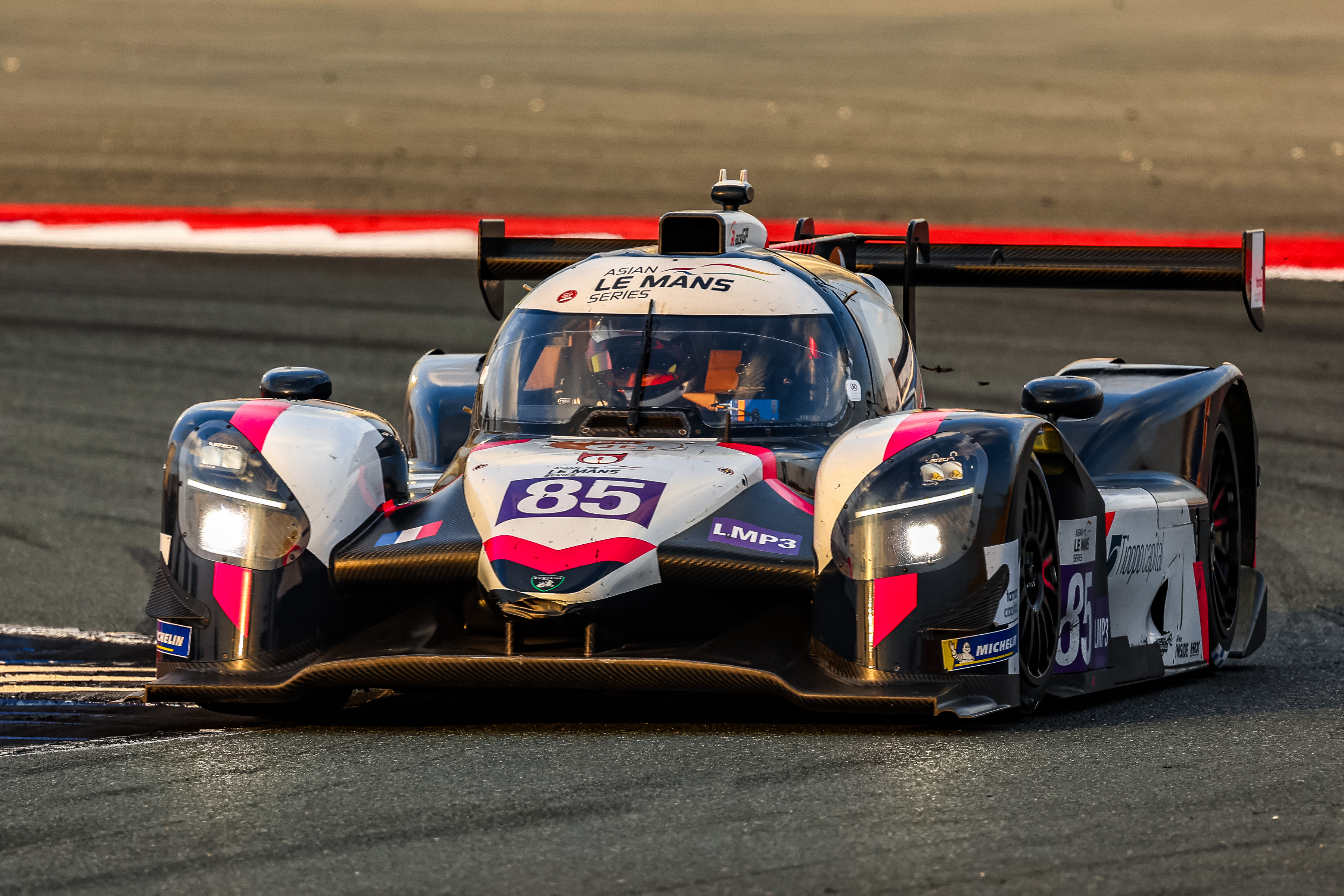
  • Léna Bühler overcomes bad luck to finish fourth in the Asian Le Mans Series

    After gearbox problems in the first race, the R-Ace GP team salvaged a fourth place in the second race after a tire failure.

    Photo by Asian Le Mans Series

    After a hard-fought qualifying session, Bühler’s teammate Sarkissian started the Nr. 85 car from 24th overall and eighth in the LMP3 class. The start of both prototype classes was clean with only a few minor fights. There was contact in the GT3 class, but it had no significant impact on the race. The Lebanese driver held eighth place behind the 23 Events Racing car and in front of Team Virage.

    Sarkissian drives inconspicuously in the first half of the race. In the second half, he manages to overtake both Ligier No. 71 and No. 23 while driving the only Duqueine.

    Photo by Asian Le Mans Series

    After nearly an hour, a Virtual Safety Car (VSC) was deployed. The No. 6 LMP2 car spun off the track and was unable to continue. However, the VSC was only activated after the driver had already exited the car; an unusual scene. The race’s neutralization caused a massive rush to the pit lane, as both the LMP3 and GT3 cars were overdue for their pit stops. Most of the cars had already pitted shortly before but returned to top up their mileage. During these stops, the R-Ace GP car moved up to fifth place in the LMP3 class. Due to the length of the VSC, it is converted into a conventional Safety Car before the restart.

    The race restarts with 2 hours and 36 minutes remaining. The R-Ace GP team quickly drops back to eighth place. After just 110 minutes of racing,  No. 85 pits again. They now follow the LMP3 pack, slightly behind.

    At the halfway point of the race, the No. 11 Corvette crashed. Although it managed to drive back to the pits, it left a trail of fluid from Turn 9 all the way into the pit lane. The safety car was deployed again. This time, the cleanup took considerably longer. When the pit lane reopened, virtually all the teams gradually entered, some with a slight delay, hoping to only need one more pit stop after the restart. R-Ace GP also entered the pits but then couldn’t get back out. With approximately 100 minutes remaining, the team had to retire the car due to gearbox problems.

    Photo by Asian Le Mans Series

    Sarkissian starts the second race one position further forward. Again, the prototype start is more orderly than in the GT class. The No. 21 Ferrari spins off the track and comes to a stop after a minor impact. After a short break, the car is able to continue under its own power, but race control has already deployed the first safety car as a precaution.

    Sarkissian drops to 8th place at the restart, but remains close to the competition. His attempt to move forward is hampered by film star Kumar, who takes out the GT3 leader No. 37 from Getspeed with his prototype, sending the car stranded off the track. A Virtual Safety Car (VSC) is then deployed to recover the Mercedes. Sarkissian goes of sequence to his rivals and initially moves up the field. However, at the restart, he falls behind several GT3 cars, leaving him in 26th place overall and 2nd in the LMP3 class.

    Photo by Asian Le Mans Series

    Even on the third attempt, the green light doesn’t stayed for long. After a collision, debris is dangerously scattered across the track. A brief full course yellow (FCY) is issued after 44 minutes of racing to allow for the recovery. The race restarts after just 5 minutes. This time, the race can really pick up speed, and the Lebanese driver tries to get into a good position and overtake the GT3 cars.

    At this point, the R-Ace GP team faces no immediate threat from behind. Sarkissian manages to maintain a consistent gap of two to three seconds to Whale of High Class Racing. Only after an hour of racing does Whale close the gap. Sarkissian is able to defend his position by repeatedly putting GT3 cars between himself and his pursuer. The battle lasts for almost 23 more minutes before the Ligier overtakes the Duqueine.

    Shortly afterwards, the 23 Events Racing car slid on the slippery asphalt and spun into the wall. The heavy impact brought out another safety car. Pit lane remained closed. When the race restarted after almost 20 minutes, many cars immediately followed into the pits, including the R-Ace GP car. Swiss driver Léna Bühler took over the cockpit and rejoined the track in third place in the LMP3 class.

    Bühler quickly closes in on Rabin ahead of her and needs only a few laps to overtake him. She is almost a lap behind the class leader, but that doesn’t mean anything yet. The leader comes into the pits just one lap later and relinquishes his lead to the Swiss driver.

    Bühler is clearly struggling with the old tires. In turn 13, she locks up her brakes badly and is unable to shake off her pursuers. Her lead lasts less than 30 minutes before she suddenly drops back. Her lap times slow down by six seconds each in the next two laps. On the third lap, it becomes clear that a slow puncture has finally given out. Bühler limps back to the pits. With 1 hour and 50 minutes remaining, Frost takes over the car from 36th overall and 7th in class, two laps behind the leaders.

    Photo by Asian Le Mans Series

    Frost battles his way through the GT3 pack to at least catch up with the other LMP3 cars. Since the other teams in the class also encounter problems and make mistakes during the third hour, he is able to overtake the GT3 cars. He works his way up to 29th overall and fifth place among the LMP3 cars in his first hour.

    The High Class Racing car pitted after just over three hours. Frost managed to overtake Voisin two laps after his stop and build a lead. This lead proved sufficient at the final pit stop, 30 minutes before the end of the race, to maintain his lead over High Class Racing. The R-Ace GP team thus salvaged fourth place after a string of bad luck in both races.

    The season finale will take place in Abu Dhabi from February 7th to 8th. After bad luck in the first four races, the R-Ace GP team can hardly compete for the title, but they can still improve their position by a few places.

  • Lilou Wadoux secures 5th place in the foggy battle of 24 Hours of Daytona

    After a fog interruption of over 6 hours, the AF Corse US team drove unleashed and thus earned a good start into the new IMSA season.

    Photo credits: Jake Galstad, IMSA Photo

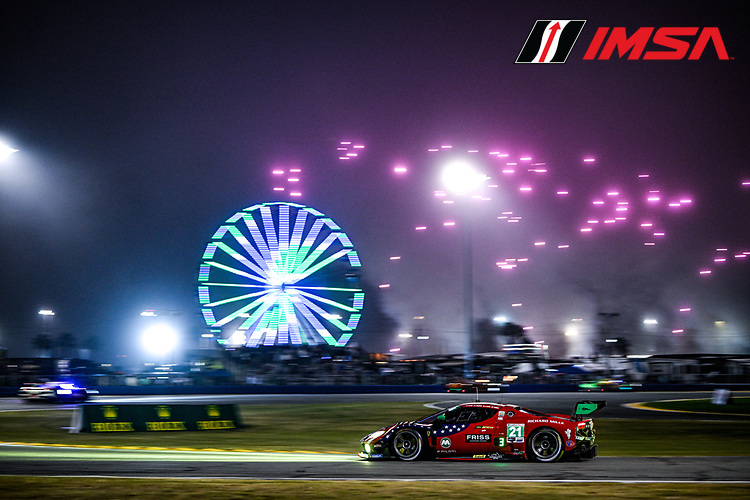
    Qualifying the day before the prestigious 24 Hours of Daytona was unusually warm, even for January in Florida. Nevertheless, the drivers needed several laps to get their tires up to operating temperature. Starting driver and Le Mans winner Antonio Fuoco took on this task in the No. 21 AF Corse US Ferrari. The GTD class was, as usual, well-represented and fiercely contested. As a result, even the Gold-class driver couldn’t secure pole position. The AF Corse US Ferrari therefore started from sixth place in the GTD class and 47th overall.

    Photo credits: Jake Galstad, IMSA Photo

    The start of the Daytona endurance classic went disastrously wrong. In the LMP2 class, several cars collided in the very first corner, including the No. 343 AO Racing and the No. 18 EMA Motorsport car. While all the cars were able to continue, a dangerous debris field now littered the first corner. Race control therefore issued the first Full Course Yellow (FCY). As the incident occurred shortly after the race start, the pit lane remained closed for the brief interruption. The race restarted just 10 minutes later. Fuoco had made a good start and had already moved up to provisional third place.

    The race didn’t stay green for long on the second attempt either. The No. 28 Porsche lost its rear end under braking for Turn 1, spun inwards, and crashed into the beginning of the pit wall on the passenger side. The car came to a stop on the track with its front wheel torn off, but the driver was uninjured. Consequently, the second FCY had to be initiated. Again, the pits remained closed, as the race had not yet run for 30 minutes. Fuoco had previously managed to push the Ferrari into second place.

    After 25 minutes, the third race start took place, and this time the green light would stay on longer. Fuoco fought tenaciously for the lead for 20 minutes before taking it on lap 14. This put the Ferrari in 32nd position overall, a position it held for 11 laps. Ellis in the Mercedes then reclaimed the lead before the first pit stops for the GTD class. These pit stops proved to be a bit of a setback for AF Corse US. Although they remained in second place, they received a drive-through penalty for an “Improper Pit Entry” after their stop. After serving the penalty, the team dropped to 12th in the GTD standings.

    Photo Credits: Brandon Badraoui, IMSA Photo

    It took until the 100th minute of the race for Fuoco to reach the top ten again, five seconds behind the Ferrari No. 023. The recovery drive now really picks up speed, and after just 20 more minutes, the team is already fighting for 7th place. Fuoco successfully prevails here as well, shortly before the third FCY occurs. This time, the reason is not a major accident, but a technical defect of the No. 62 car, which is forced to retire with a broken suspension. Since the race has been underway for some time, the pits are opened this time. The AF Corse US team is also able to get in, and Simon Mann takes over the cockpit. They rejoin the track in 41st place overall and 7th in the GTD class, behind Yoluc in the No. 36 Corvette.

    After the restart, Mann managed to gain several positions and was only 5 seconds behind the leader before he began to lose time. In his group, he was eventually overtaken by Costa and dropped back again. Mann’s run was short-lived, however, as the fourth FCY was triggered after almost 3 hours: an LMP2 car spun after turn 3 and came to a stop just before the International Horseshoe. The No. 120 Porsche couldn’t see the car in the tire smoke and collided heavily with the prototype. The pit stops during this yellow flag period dropped the team back to 7th in the GTD class. The top drivers were back at the wheel for the other competitors after the restart, so Mann as a bronze driver, slipped to 15th.

    After his second stint, Mann handed the Ferrari over to Mosca. Mosca then staged another comeback in his double stint, re-establishing himself in seventh place in the GTD class by the five-hour mark. With 18 hours and 50 minutes remaining, another FCY arrived. This only briefly interrupts Mosca’s comeback. Within the next hour, he manages to move up to fourth place before his driving time is temporarily over.

    Photo Credits: Jake Galstad, IMSA Photo

    Now it’s French factory driver Lilou Wadoux’s turn. She rejoins the track just behind Auer in the Mercedes. It takes her a few laps to find her pace, but she manages to stay 10 seconds behind the Mercedes and establish a safe gap to fourth place. Her drive in the now-falling night isn’t slowed down by the rising fog. Auer and Wadoux together manage to close the gap to the front of the class.

    The fog intensified rapidly. The lack of wind meant that it didn’t dissipate in the bowl-shaped circuit and eventually thickened to the point of being impassable. The result was a sad record in IMSA history: the longest continuous full course yellow flag period. With visibility sometimes dropping below 400 meters, resuming the race before sunrise was out of the question. Due to the driving time restrictions and the ongoing fuel consumption, positions shifted constantly as a result of the pit stops. As the slowest driver on the team, Mann completed his minimum driving time during this period to allow the professionals to take over the cockpit for the continuation of the race.

    Photo Credtis: Brandon Badraoui, IMSA Photo

    At the restart in dawn, Lilou Wadoux was back behind the wheel of the No. 21 Ferrari. A good strategy during the previous 6.5 hours under yellow flags had propelled the team to first place in the GTD class. After the wait, the Frenchwoman drove like she just waited for this, setting the team’s fastest lap of the race so far. However, she couldn’t significantly extend her lead, as she was held up by the identical GTD Pro cars. After five laps, her dream of leading was over, and Foley in the No. 46 BMW overtook her.

    At the start of the final quarter of the race, the AF Corse US team made an early pit stop and switched back to Fuoco. They initially dropped to 11th place, but after all the teams had pitted, they secured second. With 4:50 hours remaining, Fuoco pit. In the meantime, the No. 18 LMP2 car had spun in Turn 1 and stalled. Another FCY was called in to recover the car and closed the pit lane. After the restart, Fuoco moved up to second place and battled with McLaughlin. Shortly afterward, he slipped back to seventh. He managed to climb back up to third before the next pit stops.

    Mosca took over driving duties in fifth place. The competition showed their true colors in the final hours, making it difficult for Lilou Wadoux’s team to move further up the field. As the best Ferrari in class, they were stuck behind Green in the No. 13 Corvette. Instead of being able to attack, they were overtaken by Auer in the Mercedes. After an hour, Mosca returned to the pits to hand over to Wadoux once again. This time, however, they had bad luck with the next full course yellow and the closed pit exit. A few seconds after entering the pits, the No. 64 Mustang came to a halt in the oval with a severe engine failure. It had also left a large oil slick. This combination resulted in an immediate full course yellow. At the restart, Wadoux was now only in sixth place.

    Photo Credits: Brandon Badraoui, IMSA Photo

    Their pace wasn’t as good as in the morning and they struggled to keep up with the leaders’ lap times. With only 100 minutes remaining, the AF Corse US team dropped back again during the final driver change. Now in 12th place in the GTD class, it was Fuoco’s job to bring the Balance of Performance (BoP)-affected Ferrari back to the front. With the help of the other cars’ pit stops and his own pace, he even managed to climb back up to second place briefly, until the final pit stop. After that, the field was sorted out and Fuoco was in sixth position. In his last stint, he gave it his all and ultimately gained another position. In the end, the AF Corse US team crossed the finish line in fifth place in the GTD class, behind the No. 13 Corvette, and 32nd overall, behind the Aston Martin GTP. The class win went to the Winward Racing Mercedes.

    The next IMSA race of the season is also the next endurance classic of American motorsport. The 12 Hours of Sebring will take place from March 18th to 22nd.

  • Welcome to Motorgirls Magazine! This is our Journey…

    Our New Blog: Fostering Female Talent in Motorsport

    Motorgirls Magazine is both a hobby and a journalistic project that aims to raise awareness of females in motorsport and reports on their adventures. We think these women otherwise receive far too little attention.

    I myself have been involved in motorsport since childhood and have experienced a great deal. What has bothered me from an early age is the neglect of females. Women and girls in the sport are often ridiculed, discriminated against, and considered second-class, not to say unworthy. This unequal treatment, which still occurs today even in the most professional championships, has no place in the world of today – and certainly not in motorsport, which we owe primarily to women.

    But even without this gratitude, sexism is completely outdated. Physical differences between men and women are possible in competitive sports. These differences usually arise from different training opportunities and support. In motorsport, the fact that the vehicles themselves create a nearly identical playing field further contributes to this.

    To counter sexist male-dominated reporting, I specifically supported girls during my time in my youth team, later coached them, and most recently wrote exclusively about them in a blog. Now I have finally made one of my dreams come true and created my own blog about women in motorsport.

    So, what can you expect on here? I will continue writing race reports about selected, inspiring female drivers and teams. There will be success stories of drivers – even those who may no longer be active. Interviews and reports about the drivers themselves and their teams will also be included. Motorgirls Magazine aims to convey why women must play an equal role in motorsport. We explain why they are not inherently inferior to men.

    In addition to all of that, I will be sharing my own experiences from race tracks and events. You can look forward to the story of a driver who declared that women belong in the kitchen… or a scouting program that rejected the highest-placed woman because she was not beautiful enough.

    But we do not only have reading material planned for you… you will also find pictures and videos from the world of motorsport – not only from the “real world”, but also from the ever-growing world of sim racing. We will be competing with partner teams and you can follow us live or via VOD (more information to follow).

    In the long term, we aim to establish our own teams. Our objective is to provide an affordable gateway to motorsport.

    All of that and so much more will be available to read and discover on here in the coming months and weeks.

    Stay tuned and enjoy our work!

    Mika
    Owner and Editor

    P.S.: Motorgirls Magazine is a not-for-profit project aiming to make a difference. It is not a full-time job, but that does not mean we will put any less effort into it. We are always welcome your support and are happy to respond to your feedback!